Mobile marketing software helps you reach customers through SMS, push notifications, WhatsApp, and in-app messages. These platforms handle everything from bulk text campaigns to sophisticated behavioral triggers that respond to what users actually do in your app.
The category has grown beyond simple messaging tools. You'll now find customer engagement platforms, mobile analytics suites, and interactive demo solutions that let prospects experience mobile apps before downloading. This guide covers 24 options across those categories, with comparison tables, detailed reviews, and a framework for choosing the right fit.
What's inside
This guide covers 24 mobile marketing software solutions for engaging customers through SMS, push notifications, WhatsApp, and in-app messaging. You'll find a comparison table, detailed reviews of each platform, key features to evaluate, and a step-by-step selection framework. We selected tools based on G2 ratings, integration depth, channel coverage, and real-world use cases across e-commerce, B2B SaaS, and mobile-first companies.
TL;DR
- Best for enterprise engagement: Braze delivers cross-channel orchestration with AI personalization
- Best for SMS marketing: Attentive leads with AI-powered text messaging for e-commerce
- What to prioritize: Multi-channel messaging, automation workflows, analytics integration, and compliance features
- Key consideration: Match platform capabilities to your specific mobile marketing goals and existing tech stack
What is mobile marketing software
Mobile marketing software enables businesses to engage customers via SMS, push notifications, WhatsApp, and in-app messages. The category has expanded from simple bulk SMS tools to include sophisticated customer engagement platforms, andmobile analytics suites.
How mobile marketing platforms work
The basic workflow follows a predictable pattern:
- Data collection: Capture phone numbers, app installs, and opt-ins from your website, app, or point-of-sale systems
- Segmentation: Group contacts by behavior, demographics, location, or purchase history
- Campaign creation: Build SMS, push, or in-app messages using templates or custom designs
- Automation: Trigger messages based on user actions like cart abandonment or milestone events
- Analytics: Measure opens, clicks, conversions, and revenue attribution
Most platforms integrate with your CRM and e-commerce systems to keep customer profiles synchronized.
Types of mobile marketing tools
The mobile marketing software landscape breaks down into several categories:
- SMS and MMS platforms: Text message marketing tools that handle bulk messaging and compliance
- Push notification tools: App-based alert systems that deliver messages to users with your app installed
- Customer engagement platforms: Multi-channel solutions that orchestrate messaging across SMS, push, in-app, and email
- Mobile analytics and attribution: Campaign measurement tools that track user acquisition and effectiveness
- Interactive demo platforms: Solutions that let prospects experience mobile apps in-browser before downloading
- Conversational marketing: Two-way messaging and chatbot tools for real-time customer conversations
When to use mobile marketing software
Different business situations call for different mobile marketing approaches.
Customer engagement and retention campaigns
When you're trying to re-engage existing users, send loyalty rewards, or recover abandoned carts, mobile marketing software becomes essential. Subscription businesses and e-commerce brands typically see the highest ROI here because mobile messages reach customers where they already spend time.
App marketing and user acquisition
If you're launching or growing a mobile app, you'll want tools that drive downloads, onboard new users, and reduce churn. App marketing platforms combine push notifications, in-app messaging, and deep linking to guide users through their first experiences.
E-commerce and retail mobile campaigns
Promotions, flash sales, order updates, and location-based offers all perform well through mobile channels - Listrak's 2025 benchmark found retailers' SMS volume surged 93% year-over-year. SMS marketing works particularly well for time-sensitive campaigns, with open rates between 90% and 98%.
B2B mobile product demonstrations
When you're selling a mobile app to business buyers, the traditional "book a demo" flow creates friction. Prospects want to see the product before committing time to a call. Interactive demos let buyers experience your mobile product in their browser without downloading anything.
Mobile marketing software comparison table
| # | Product | Best for | Key differentiator | Pricing | G2 rating |
|---|---|---|---|---|---|
| 1 | Braze | Enterprise engagement | Cross-channel AI orchestration | Custom | 4.5/5 |
| 2 | CleverTap | Mobile-first analytics | Behavioral segmentation depth | Custom | 4.6/5 |
| 3 | Iterable | Growth team workflows | Visual journey builder | Custom | 4.4/5 |
| 4 | OneSignal | Push notifications | Free tier accessibility | Free + $9/mo | 4.7/5 |
| 5 | Airship | Enterprise mobile | App experience platform | Custom | 4.3/5 |
| 6 | MoEngage | Emerging markets | AI-powered engagement | Custom | 4.5/5 |
| 7 | Insider | E-commerce personalization | Cross-platform AI | Custom | 4.7/5 |
| 8 | Attentive | SMS marketing | AI text personalization | Custom | 4.8/5 |
| 9 | Klaviyo | E-commerce SMS/email | Shopify integration | Free + $20/mo | 4.6/5 |
| 10 | Postscript | Shopify SMS | Conversational commerce | $25/mo | 4.7/5 |
| 11 | Omnisend | Multi-channel e-commerce | Pre-built automation | Free + $16/mo | 4.6/5 |
| 12 | Pushwoosh | App developers | Event-triggered campaigns | Free + $49/mo | 4.7/5 |
| 13 | Leanplum | A/B testing focus | Behavioral analytics | Custom | 4.2/5 |
| 14 | Salesforce Marketing Cloud | Enterprise ecosystem | Mobile Studio integration | Custom | 4.0/5 |
| 15 | Adobe Campaign | Enterprise personalization | Experience Cloud integration | Custom | 4.1/5 |
| 16 | Oracle Responsys | Large retail/finance | Cross-channel orchestration | Custom | 3.9/5 |
| 17 | Acoustic | Mid-market automation | Former IBM Watson tech | Custom | 4.0/5 |
| 18 | Customer.io | Data-driven SaaS | Flexible event triggers | $100/mo | 4.4/5 |
| 19 | Cordial | Real-time retail | Data-first personalization | Custom | 4.6/5 |
| 20 | Netmera | Gaming and media | Strong mobile analytics | Custom | 4.5/5 |
| 21 | WebEngage | APAC markets | Journey designer | Custom | 4.5/5 |
| 22 | Notix | Publishers | Free push notifications | Free + $5/mo | 4.6/5 |
| 23 | Kumulos | App developers | ASO features included | $100/mo | 4.4/5 |
| 24 | Localytics | Enterprise apps | Behavioral targeting | Custom | 4.1/5 |
24 best mobile marketing software solutions reviewed
We selected tools based on user reviews, feature depth, integration capabilities, and real-world use cases. The list spans SMS platforms, push notification services, customer engagement suites, and mobile demo tools.
1. Braze
Braze is an enterprise customer engagement platform that orchestrates messaging across SMS, push notifications, in-app messages, email, and connected devices. The platform uses AI to personalize content and optimize send times based on individual user behavior patterns.
Best for: Large consumer brands running sophisticated cross-channel campaigns that require real-time personalization at scale.
Key strengths
- Cross-channel orchestration: Coordinate messaging across mobile, web, email, and connected devices from a single canvas
- AI-powered personalization: Automatically optimize content, timing, and channel selection
- Real-time data streaming: React to user actions within milliseconds
- Currents data export: Stream engagement data to your data warehouse
Pricing: Custom pricing based on monthly active users. Typically starts in the mid-five figures annually.
2. CleverTap
CleverTap combines customer engagement with deep behavioral analytics, giving mobile-first companies a unified view of user actions and tools to respond with targeted campaigns.
Best for: Mobile-first companies that want to understand user behavior patterns and automate engagement based on insights.
Key strengths
- Behavioral cohort analysis: Group users by actions to identify patterns that predict retention or churn
- RFM segmentation: Automatically categorize users by recency, f requency, and monetary value
- Predictive churn scoring: Identify at-risk users before they leave
- Journey orchestration: Build multi-step campaigns that adapt based on user responses
Pricing: Custom pricing based on monthly active users. Free tier available for startups.
3. Iterable
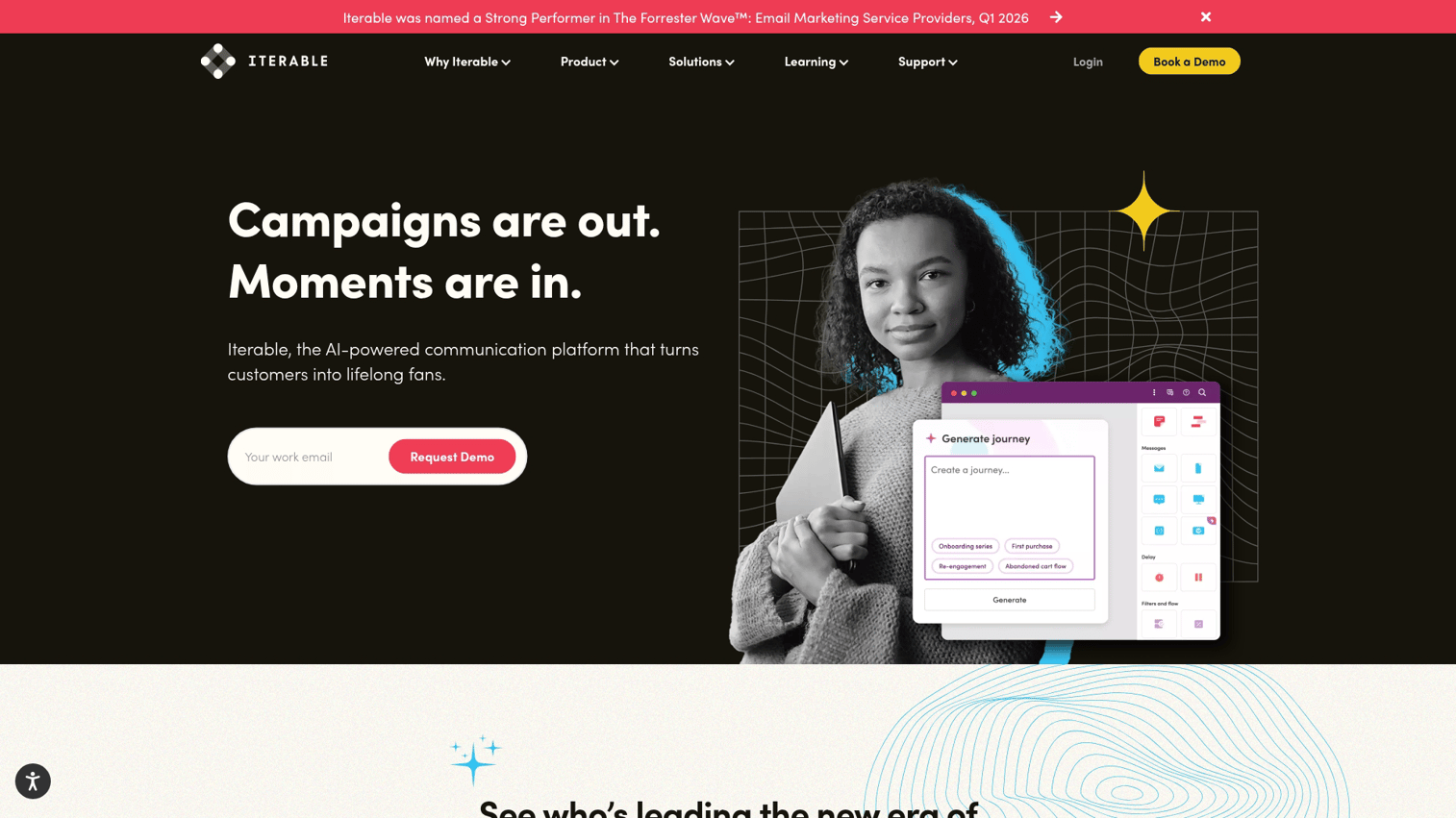
Iterable is a cross-channel marketing platform built for growth teams that want to create sophisticated customer journeys without heavy engineering support.
Best for: Growth and marketing teams at scaling companies that want complex multi-channel campaigns without constant engineering involvement.
Key strengths
- Visual journey builder: Create branching, multi-channel workflows with drag-and-drop simplicity
- Catalog and event data: Personalize messages using product catalogs and real-time behavioral events
- AI optimization: Automatically select the best channel, timing, and content for each user
- Experimentation framework: Run A/B tests across entire journeys
Pricing: Custom pricing based on contacts and message volume.
4. OneSignal
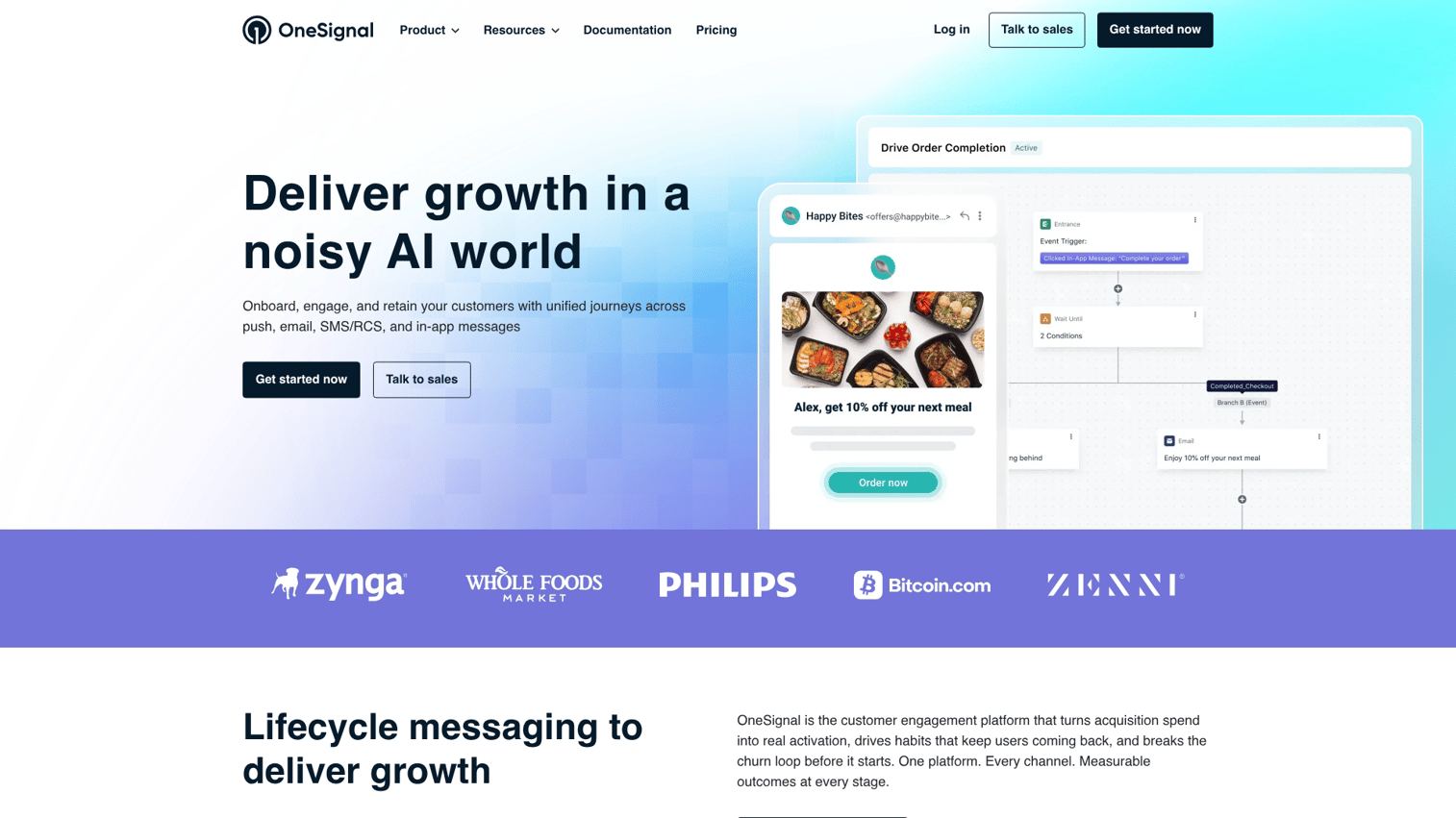
OneSignal started as a push notification platform and has expanded to include in-app messaging, email, and SMS. The generous free tier makes it accessible to startups and small teams.
Best for: Startups and SMBs that want reliable push notifications without significant upfront investment.
Key strengths
- Generous free tier: Send unlimited push notifications to up to 10,000 subscribers at no cost
- Quick implementation: SDK integration typically takes hours
- Segmentation and targeting: Filter audiences by tags, location, language, and custom attributes
- Multi-channel expansion: Add email, SMS, and in-app messaging as you scale
Pricing: Free plan for up to 10,000 subscribers. Growth plans start at $9/month.
5. Airship
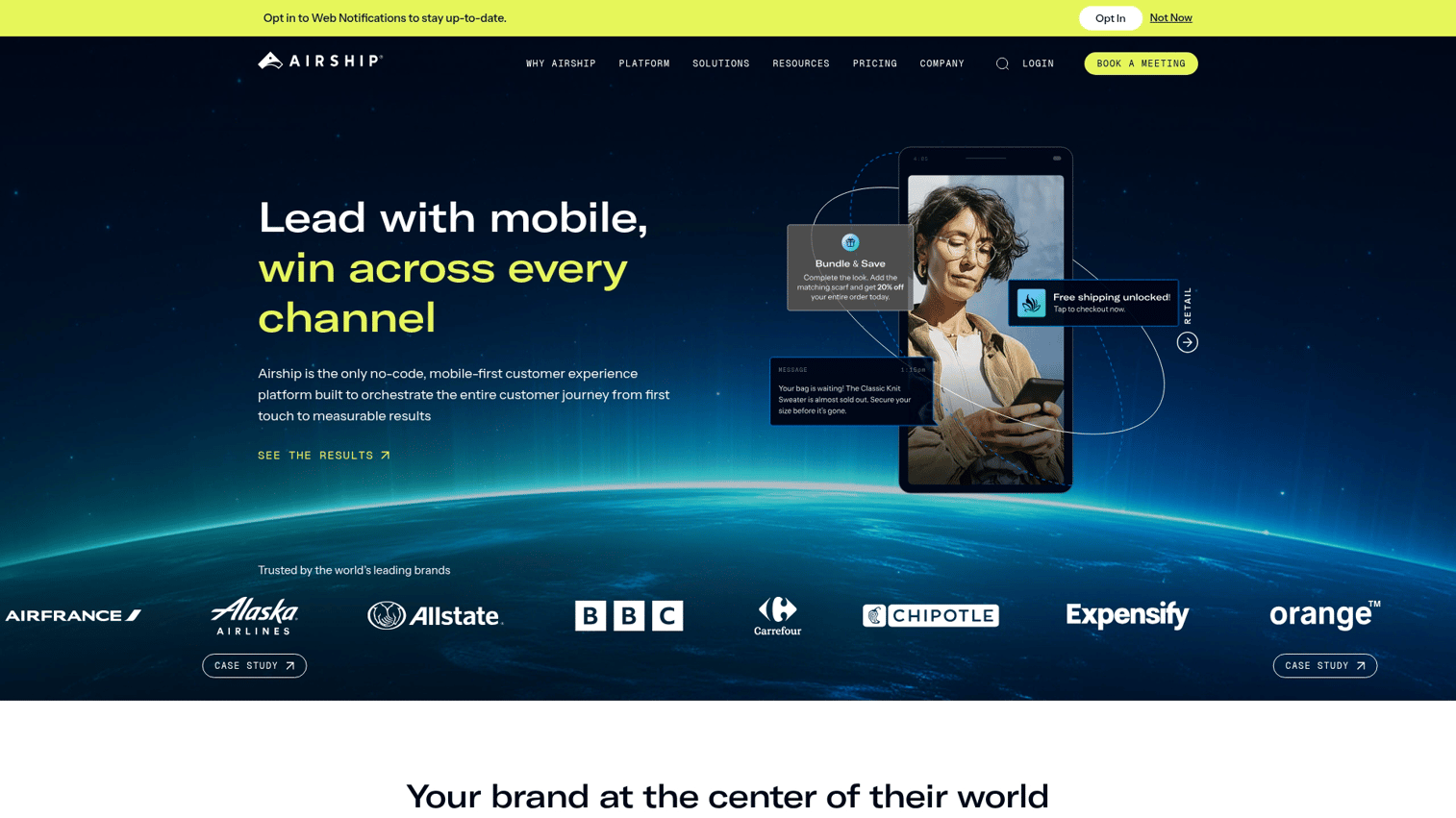
Airship positions itself as an app experience platform, going beyond messaging to include app store optimization, in-app surveys, and preference centers.
Best for: Large consumer apps that want to optimize the entire mobile experience from app store discovery through ongoing engagement.
Key strengths
- App store optimization: Tools to improve app store listings and drive organic downloads
- Preference centers: Let users control notification preferences to reduce opt-outs
- Scenes and surveys: Create in-app experiences for onboarding and feedback collection
- Real-time automation: Trigger messages based on location, behavior, and external events
Pricing: Custom pricing based on monthly active users.
6. MoEngage
MoEngage is an AI-powered customer engagement platform with particular strength in emerging markets like India and Southeast Asia.
Best for: Companies with significant user bases in emerging markets that want AI-powered engagement without enterprise-level pricing.
Key strengths
- Sherpa AI: Predictive analytics that identify optimal send times, channels, and content
- Smart triggers: Automatically detect and respond to user behavior patterns
- Regional expertise: Strong support and infrastructure in APAC and emerging markets
Pricing: Custom pricing. Generally more accessible than comparable enterprise platforms.
7. Insider
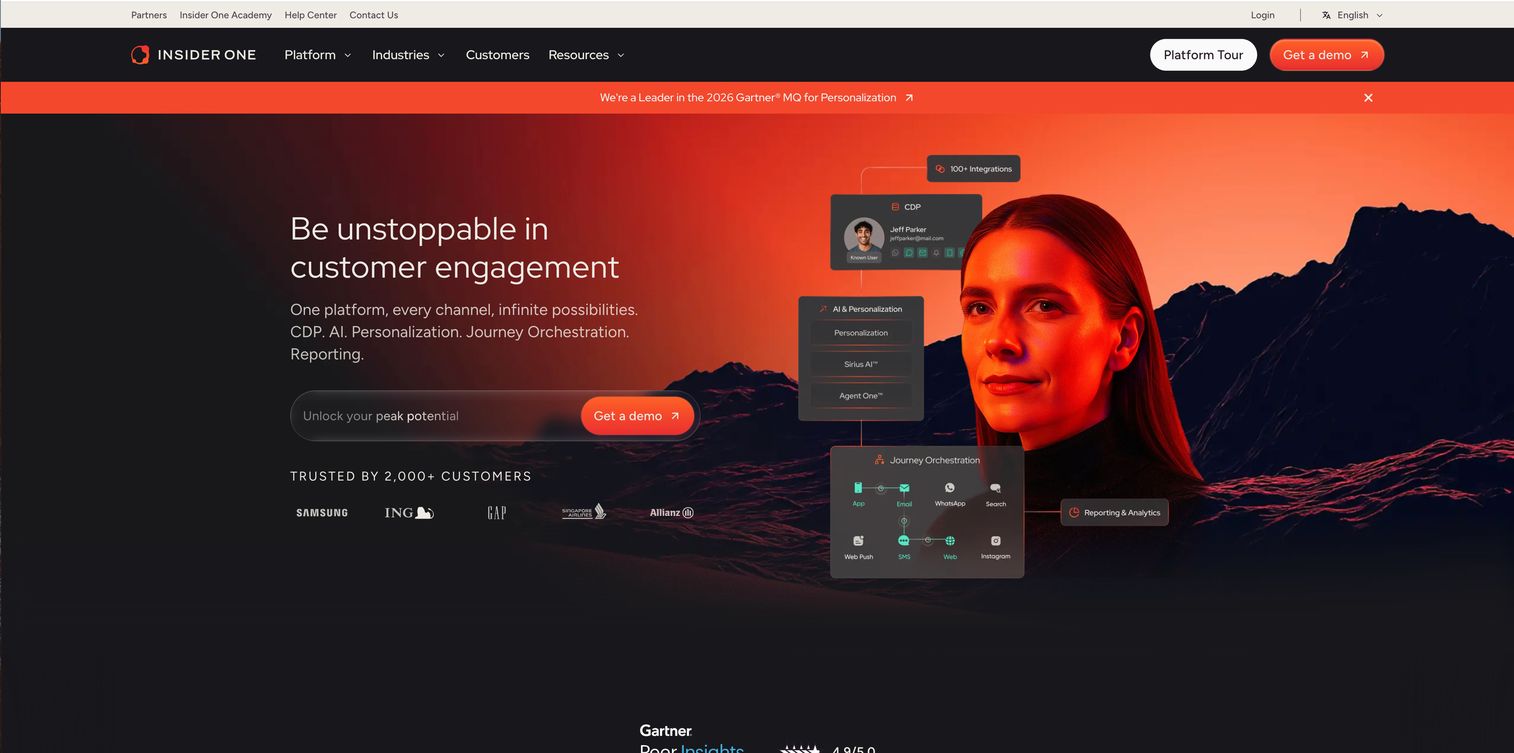
Insider is a growth management platform that uses AI to personalize experiences across web, mobile, and messaging channels.
Best for: E-commerce brands that want AI-powered personalization across their entire digital presence.
Key strengths
- Cross-platform personalization: Consistent experiences across web, mobile app, email, SMS, and WhatsApp
- Predictive segmentation: AI identifies users likely to purchase, churn, or respond to specific offers
- Template library: Pre-built campaigns for common e-commerce scenarios
- WhatsApp commerce: Native support for conversational commerce
Pricing: Custom pricing based on monthly active users.
8. Attentive
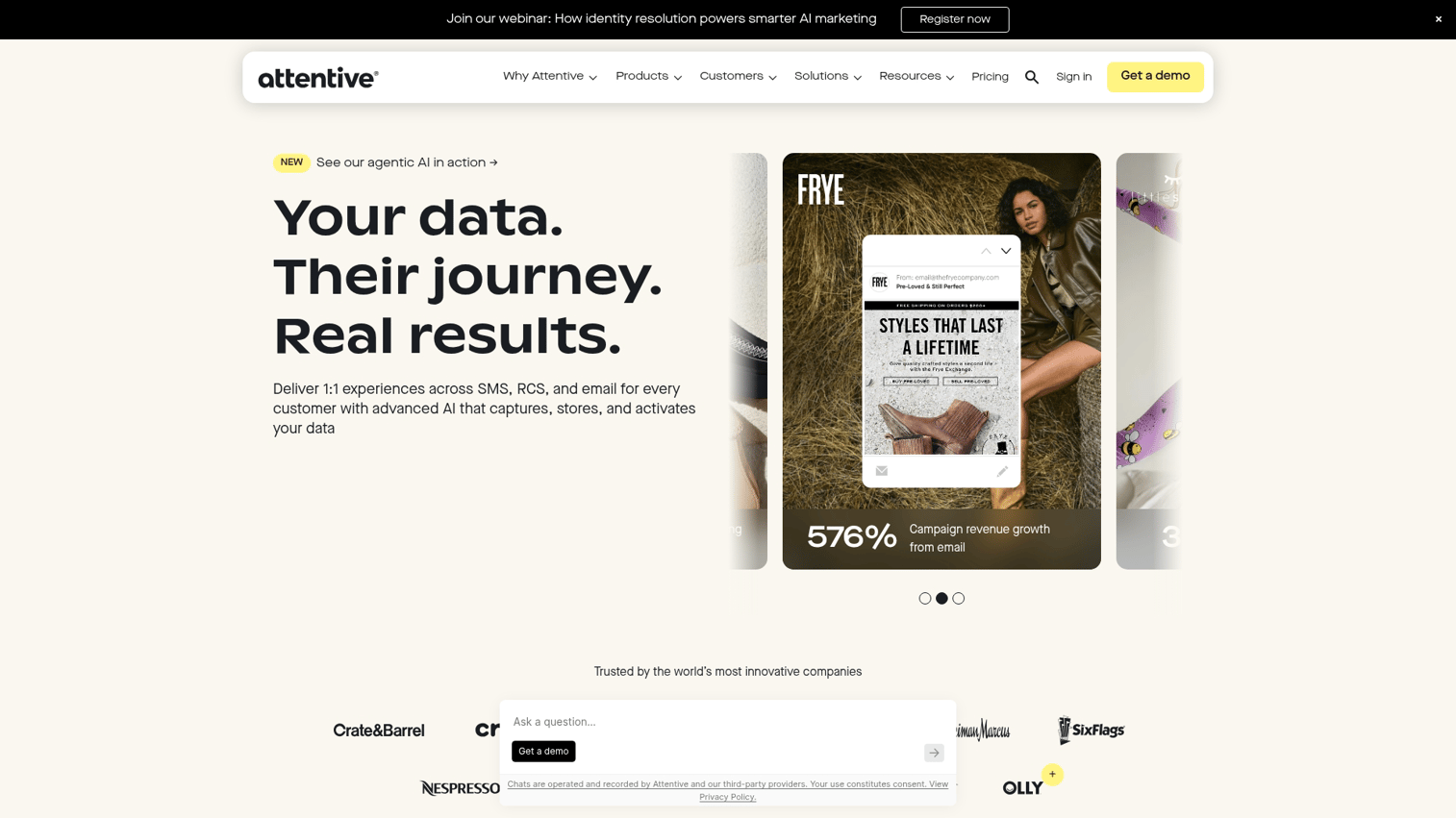
Attentive focuses specifically on SMS and MMS marketing, using AI to personalize text messages and optimize send times.
Best for: E-commerce brands that want to make SMS a primary revenue channel with AI-powered personalization.
Key strengths
- AI message generation: Automatically create personalized text messages based on user behavior
- Two-way conversations: Enable customers to respond and engage in real conversations
- Compliance built-in: TCPA compliance features including opt-in management and quiet hours
- Revenue attribution: Track exactly how much revenue each SMS campaign generates
Pricing: Custom pricing based on subscriber count and message volume.
9. Klaviyo
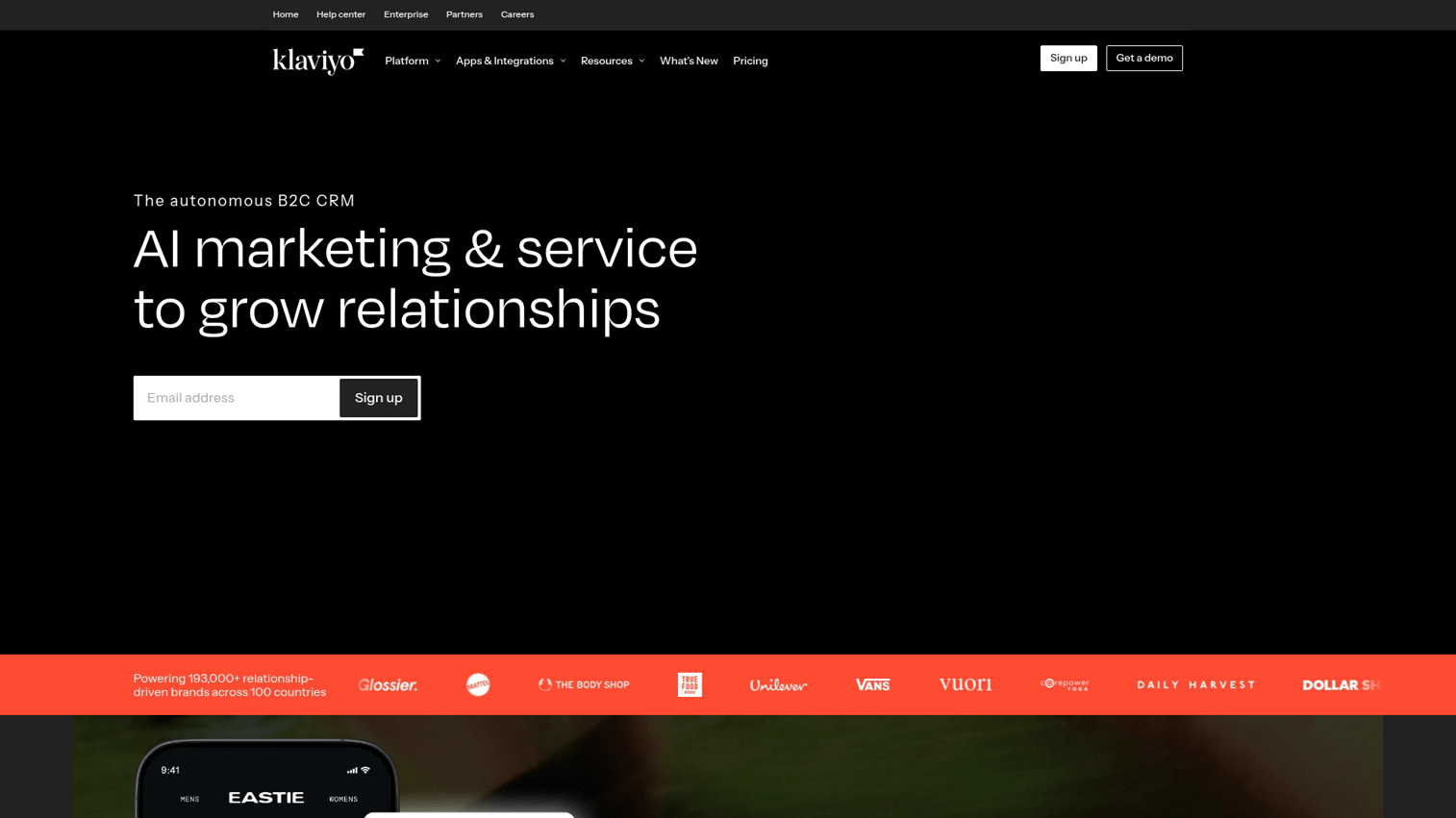
Klaviyo combines email and SMS marketing with deep e-commerce integrations, particularly for Shopify stores.
Best for: E-commerce brands, especially on Shopify, that want unified email and SMS marketing.
Key strengths
- Shopify integration depth: Native sync of customer, order, and product data
- Predictive analytics: Forecast customer lifetime value, churn risk, and next purchase timing
- Unified profiles: Single view of each customer across email and SMS
- Pre-built flows: Templates for common e-commerce scenarios
Pricing: Free for up to 250 contacts. Paid plans start at $20/month.
10. Postscript
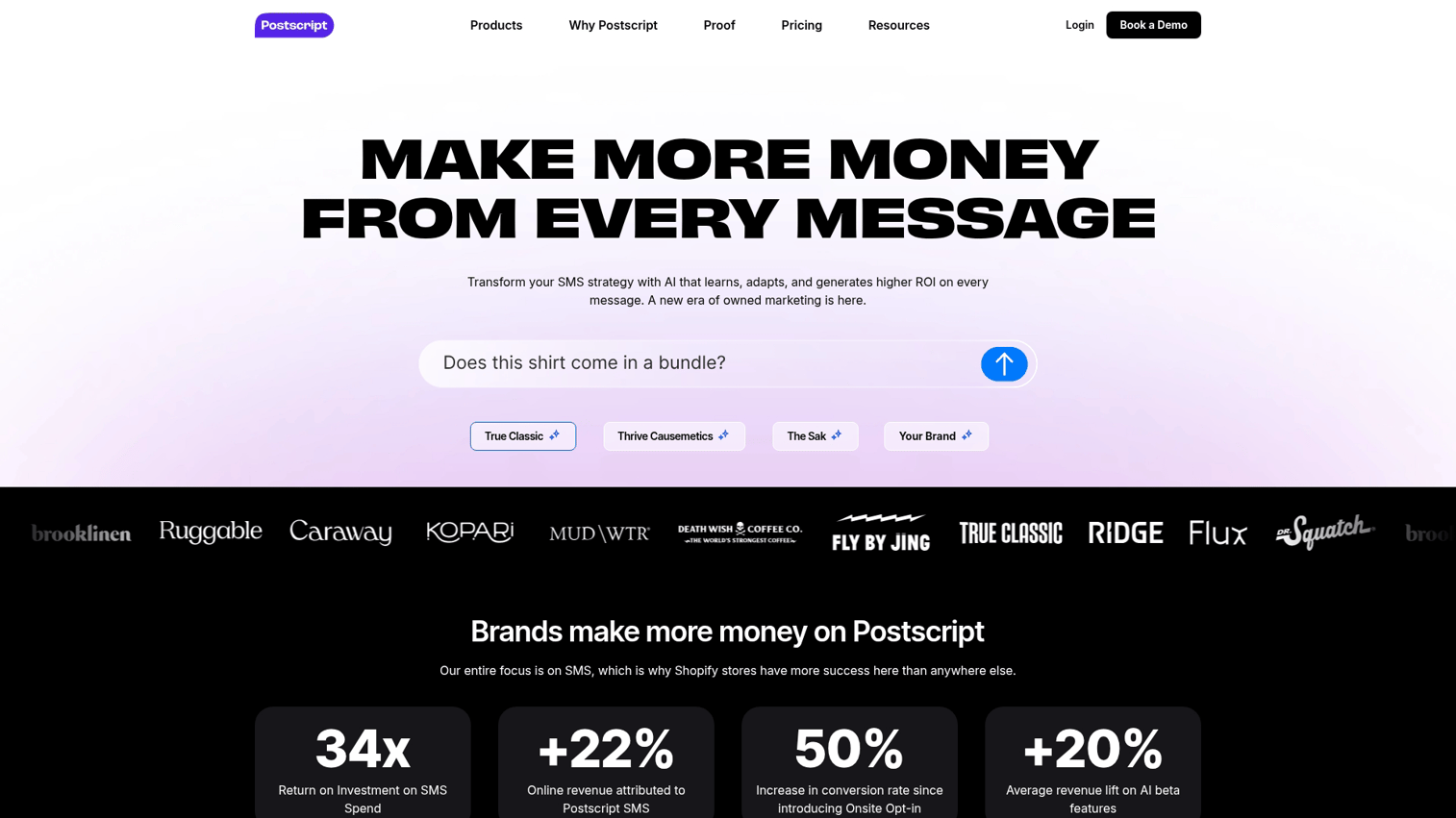
Postscript is an SMS marketing platform built specifically for Shopify stores, with a focus on conversational commerce.
Best for: Shopify merchants that want SMS to feel like a conversation, not a broadcast channel.
Key strengths
- Conversational flows: Build two-way SMS experiences that feel personal
- Subscriber growth tools: Pop-ups, keywords, and checkout opt-ins designed for Shopify
- Revenue tracking: See exactly which messages drive sales with Shopify-native attribution
Pricing: Plans start at $25/month plus per-message costs.
11. Omnisend
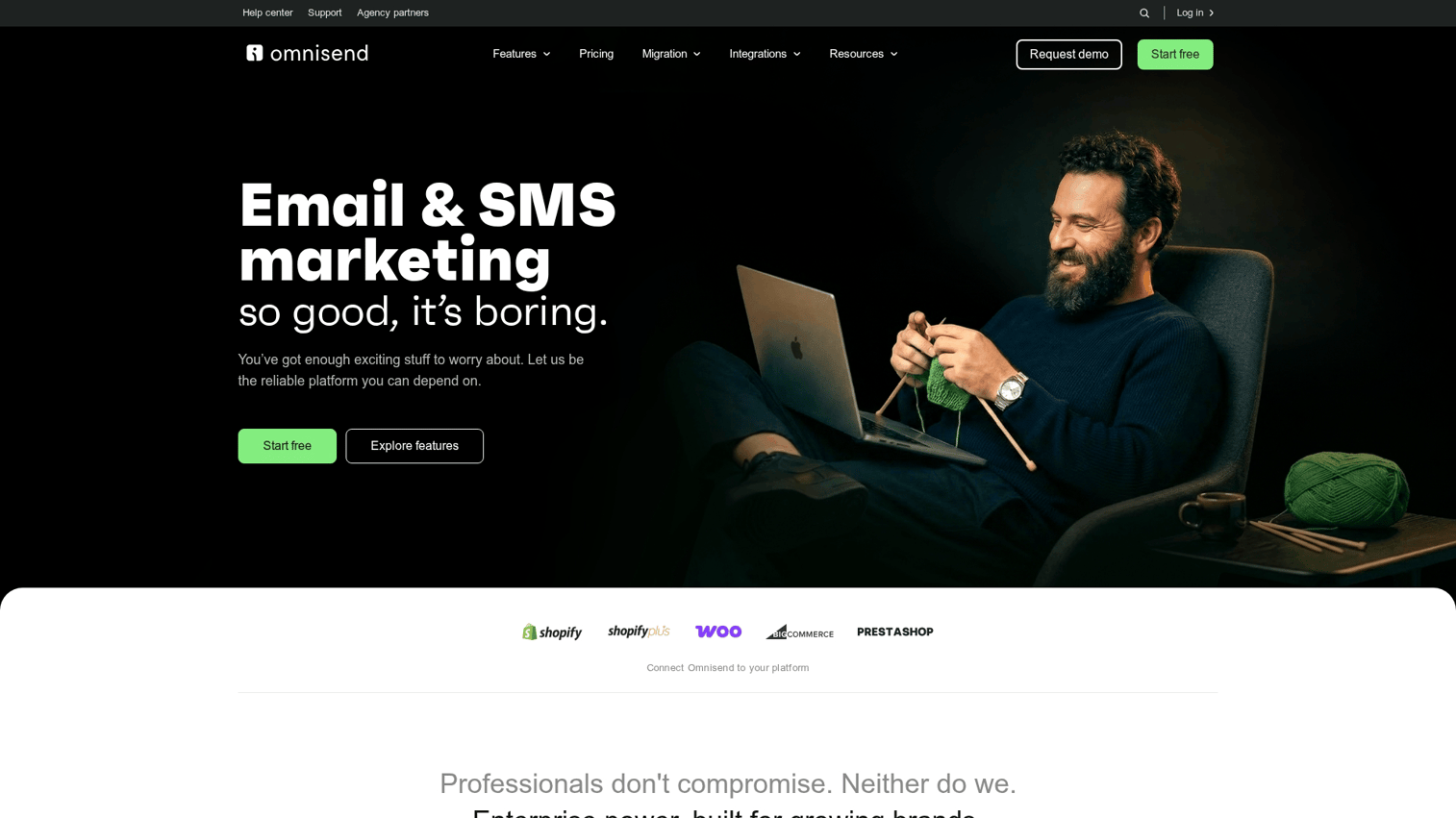
Omnisend is a marketing automation platform for e-commerce that combines email, SMS, and push notifications in one tool.
Best for: E-commerce teams that want multi-channel automation without enterprise complexity.
Key strengths
- Pre-built workflows: Templates for welcome series, cart abandonment, and post-purchase follow-up
- Multi-channel campaigns: Combine email, SMS, and push in single automated sequences
- E-commerce integrations: Native connections to Shopify, WooCommerce, and BigCommerce
Pricing: Free plan available. Paid plans start at $16/month.
12. Pushwoosh
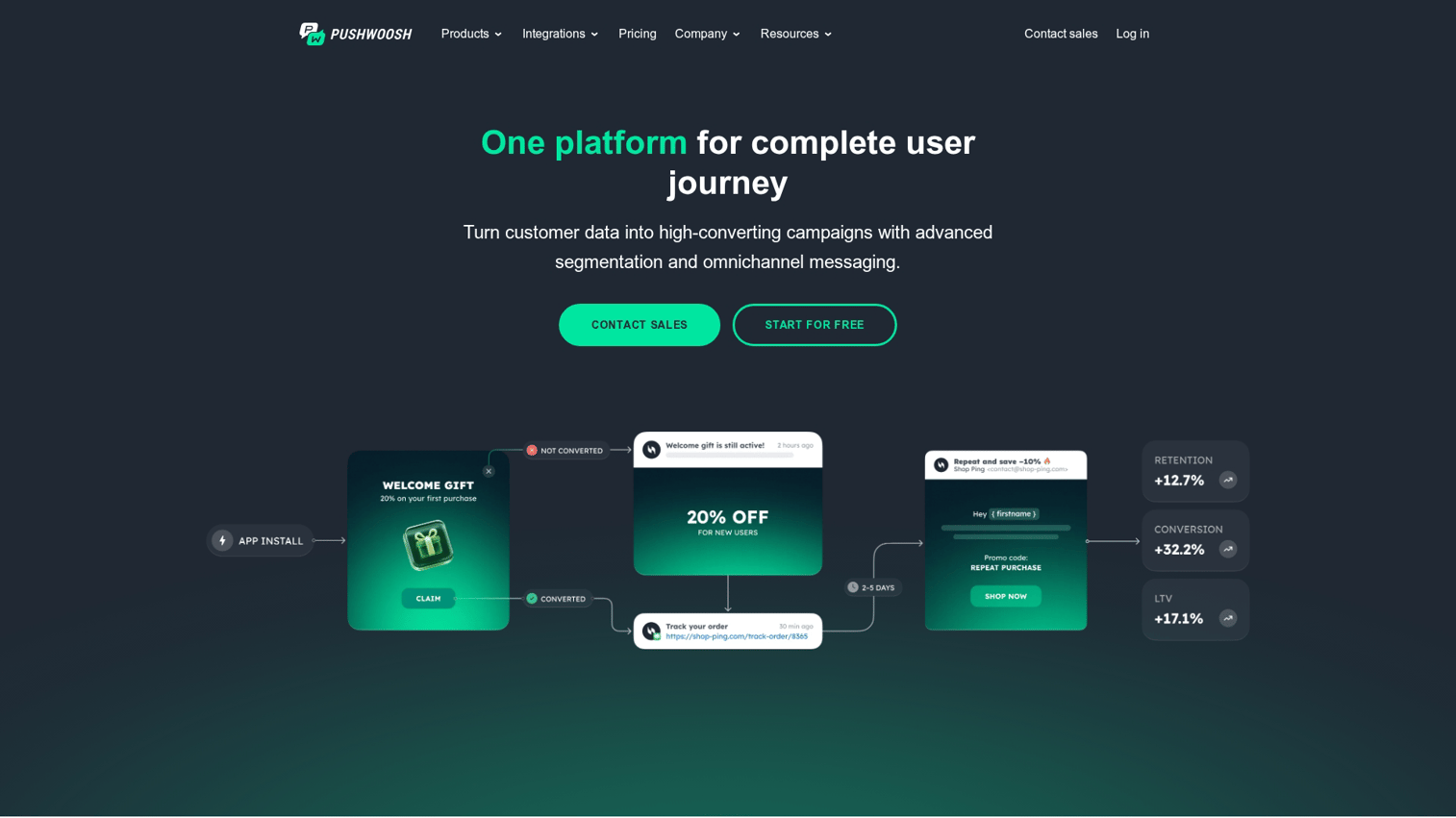
Pushwoosh is a push notification and in-app messaging platform designed for mobile app developers.
Best for: Mobile app developers and product teams that want granular control over push notification logic.
Key strengths
- Event-based triggers: Fire notifications based on specific in-app actions
- Deep linking: Send users directly to specific screens within your app
- A/B testing: Test notification content, timing, and targeting
- Multi-platform support: iOS, Android, web, and cross-platform frameworks
Pricing: Free plan for up to 1,000 devices. Paid plans start at $49/month.
13. Leanplum
Leanplum combines mobile engagement with A/B testing and behavioral analytics.
Best for: Product-led mobile apps that want to experiment with messaging and in-app experiences.
Key strengths
- In-app A/B testing: Test UI changes and messaging without app store updates
- Behavioral analytics: Understand how users interact with your app
- Lifecycle campaigns: Automate onboarding, re-engagement, and retention sequences
Pricing: Custom pricing based on monthly active users.
14. Salesforce Marketing Cloud
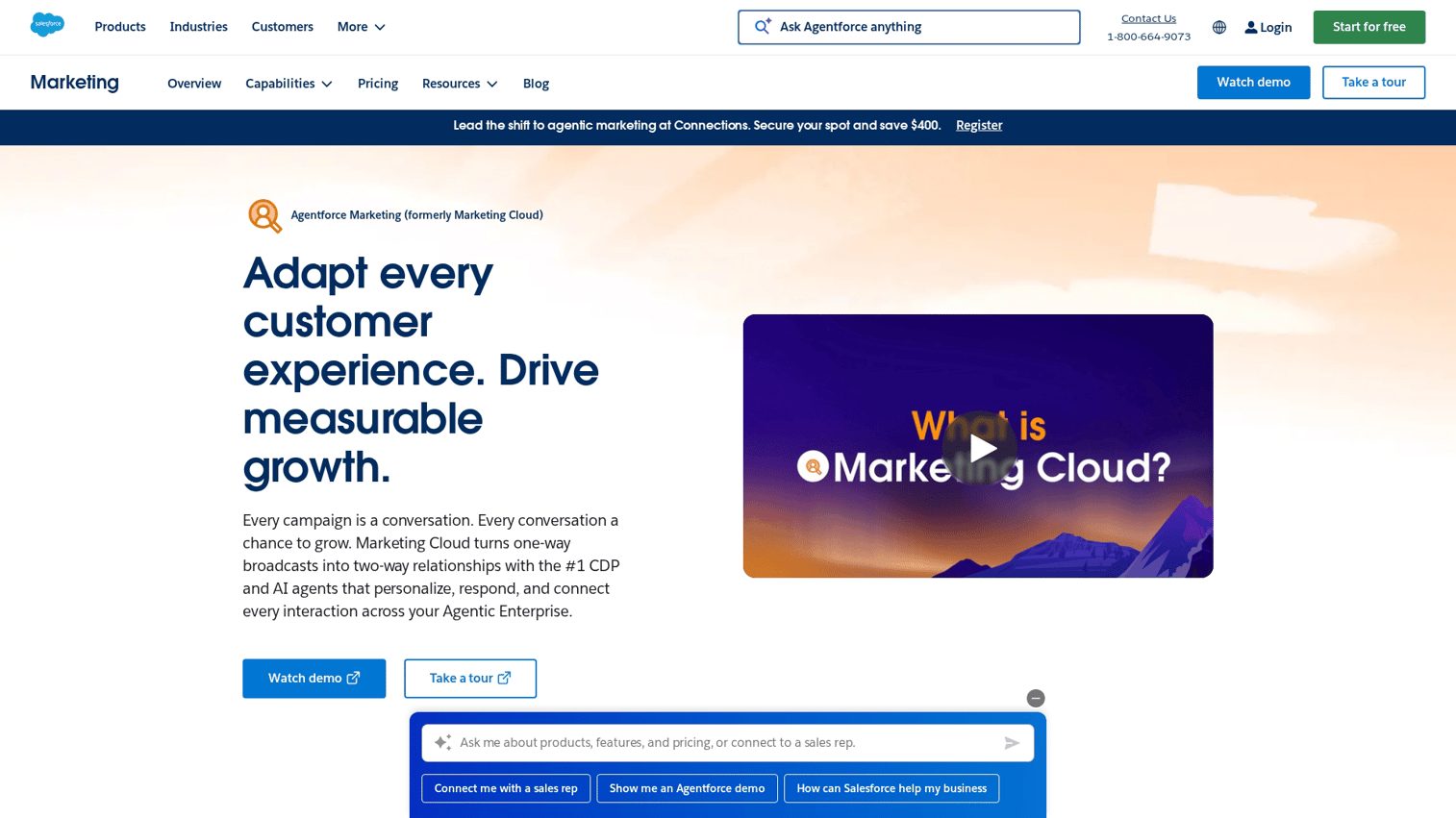
Salesforce Marketing Cloud includes Mobile Studio for SMS, push notifications, and in-app messaging as part of its broader marketing automation suite.
Best for: Enterprise companies already invested in the Salesforce ecosystem.
Key strengths
- Salesforce integration: Native connection to Sales Cloud and Service Cloud
- Journey Builder: Visual workflow tool for cross-channel campaign orchestration
- Einstein AI: Predictive analytics and optimization
Pricing: Custom pricing. Typically enterprise-level investment starting in six figures annually.
15. Adobe Campaign
Adobe Campaign is an enterprise cross-channel marketing platform that includes mobile messaging as part of Adobe Experience Cloud.
Best for: Enterprise companies using Adobe Experience Cloud.
Key strengths
- Experience Cloud integration: Connects with Adobe Analytics, Target, and other products
- Cross-channel orchestration: Coordinate mobile, email, and direct mail
- Enterprise governance: Approval workflows, audit trails, and compliance features
Pricing: Custom enterprise pricing.
16. Oracle Responsys
Oracle Responsys is an enterprise campaign management platform with mobile messaging capabilities.
Best for: Large retail and financial services companies with enterprise compliance requirements.
Key strengths
- Cross-channel orchestration: Coordinate campaigns across email, mobile, web, and social
- Advanced segmentation: Complex audience building with multiple data sources
- Compliance features: Built for regulated industries
Pricing: Custom enterprise pricing.
17. Acoustic
Acoustic is a marketing automation platform with mobile capabilities, positioned for mid-market and enterprise companies.
Best for: Mid-market companies that want marketing automation with mobile capabilities.
Key strengths
- Campaign automation: Visual workflow builder for multi-channel campaigns
- Personalization: AI-powered content and timing optimization
- Integration flexibility: Connects with various CRM and e-commerce platforms
Pricing: Custom pricing based on contacts and features.
18. Customer.io
Customer.io is a behavioral messaging platform that lets you build data-driven campaigns across email, SMS, push, and in-app channels.
Best for: SaaS and product-led companies that want to trigger messages based on specific user events.
Key strengths
- Event-driven messaging: Trigger campaigns based on any event you track
- Visual journey builder: Create complex workflows with branching logic
- Data flexibility: Use any data you collect to personalize and target messages
- Developer-friendly: API-first approach with strong documentation
Pricing: Essentials starts at $100/month for up to 5,000 profiles.
19. Cordial
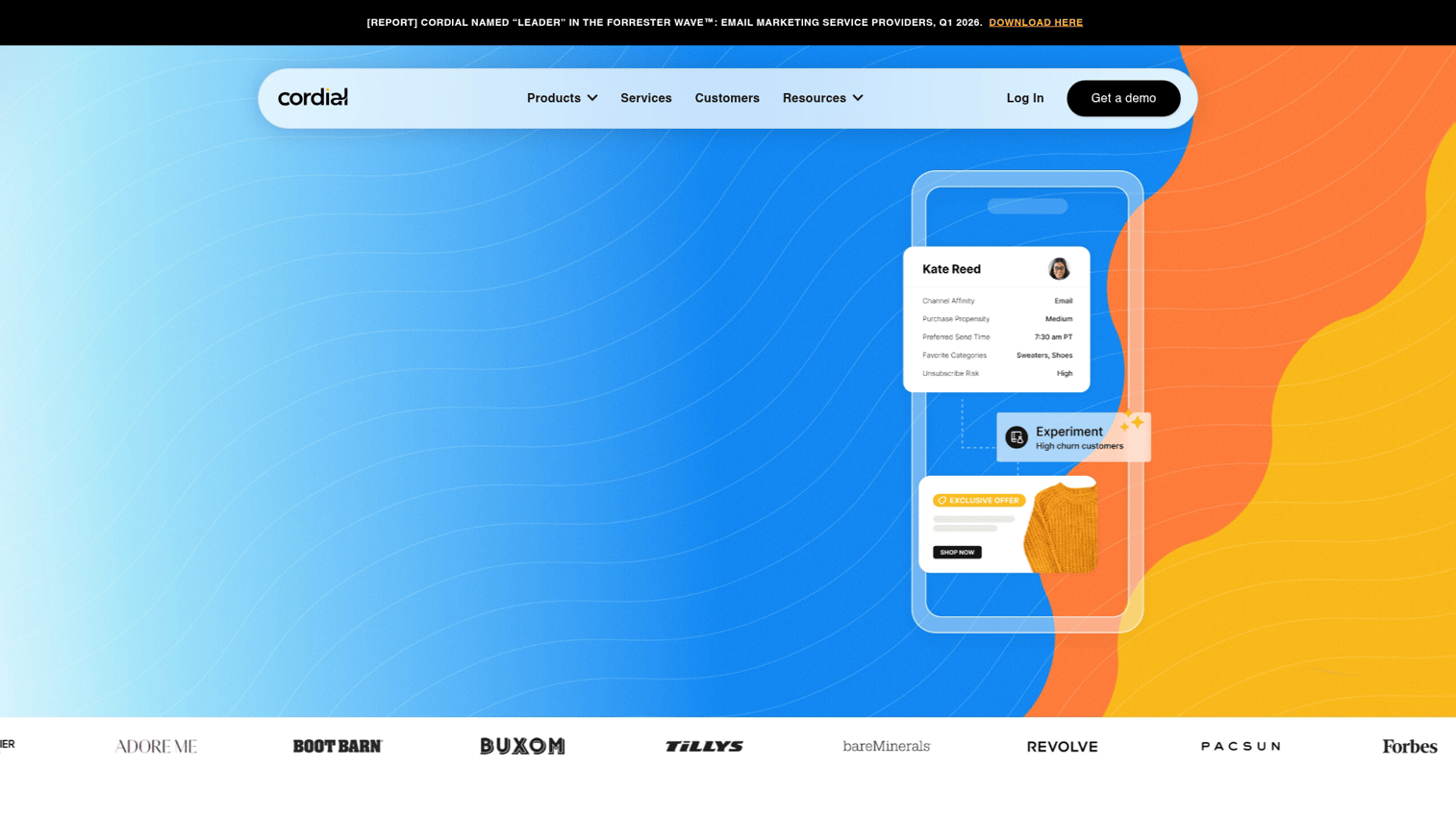
Cordial is a data-first marketing platform that emphasizes real-time personalization for retail and media companies.
Best for: Retail and media companies that want real-time personalization based on current customer behavior.
Key strengths
- Real-time data processing: Personalize messages based on what customers are doing right now
- Flexible data model: Ingest and use any data without rigid schemas
- Cross-channel messaging: Coordinate email, SMS, push, and in-app from unified profiles
Pricing: Custom pricing based on contacts and message volume.
20. Netmera
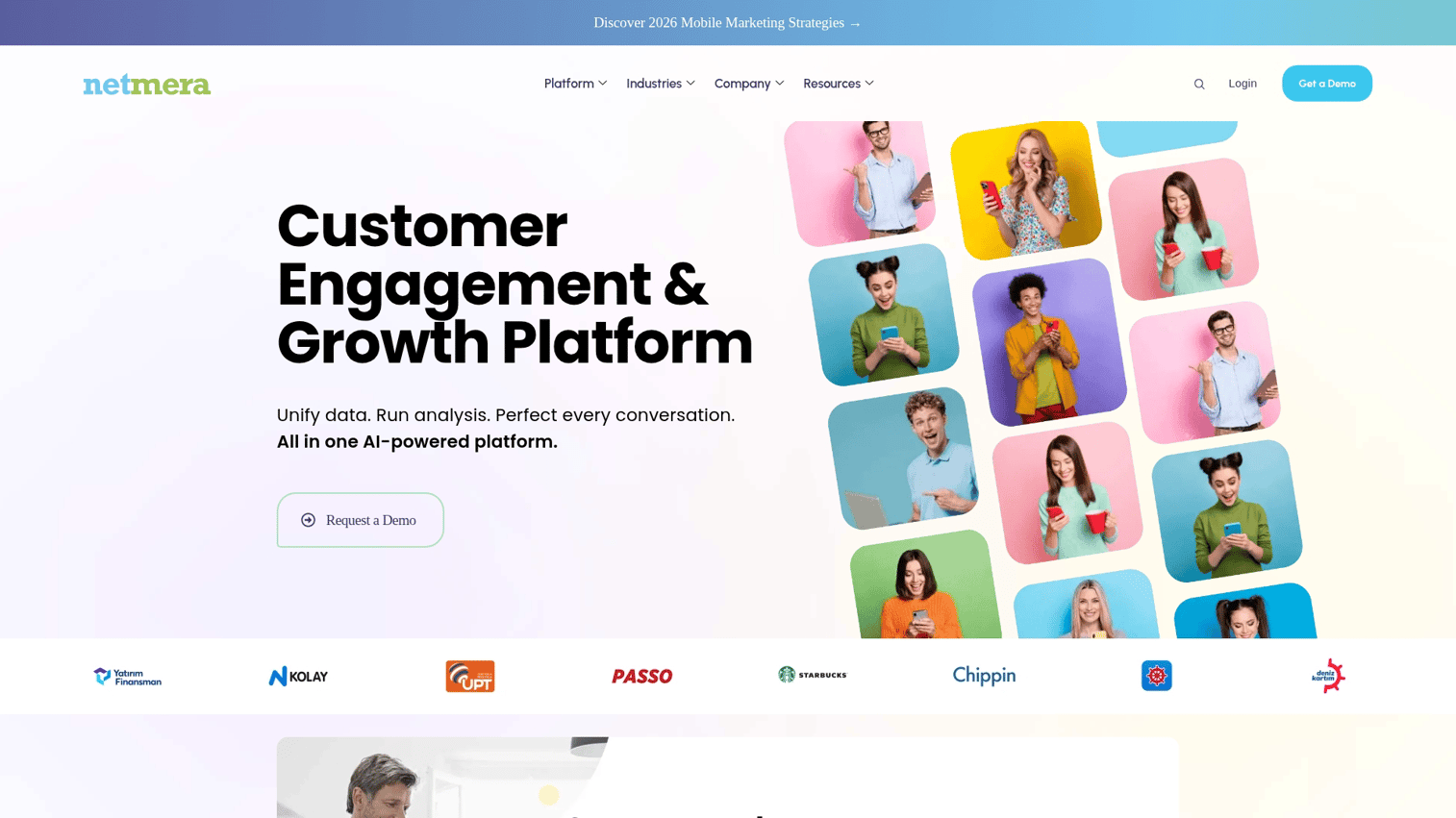
Netmera is a mobile engagement platform with strong analytics capabilities, particularly popular with gaming and media companies.
Best for: Gaming and media apps that want deep mobile analytics combined with engagement tools.
Key strengths
- Mobile analytics: Detailed tracking of in-app behavior and user journeys
- Push and in-app messaging: Targeted notifications based on user segments
- Geofencing: Location-based triggers for relevant messaging
Pricing: Custom pricing based on monthly active users.
21. WebEngage
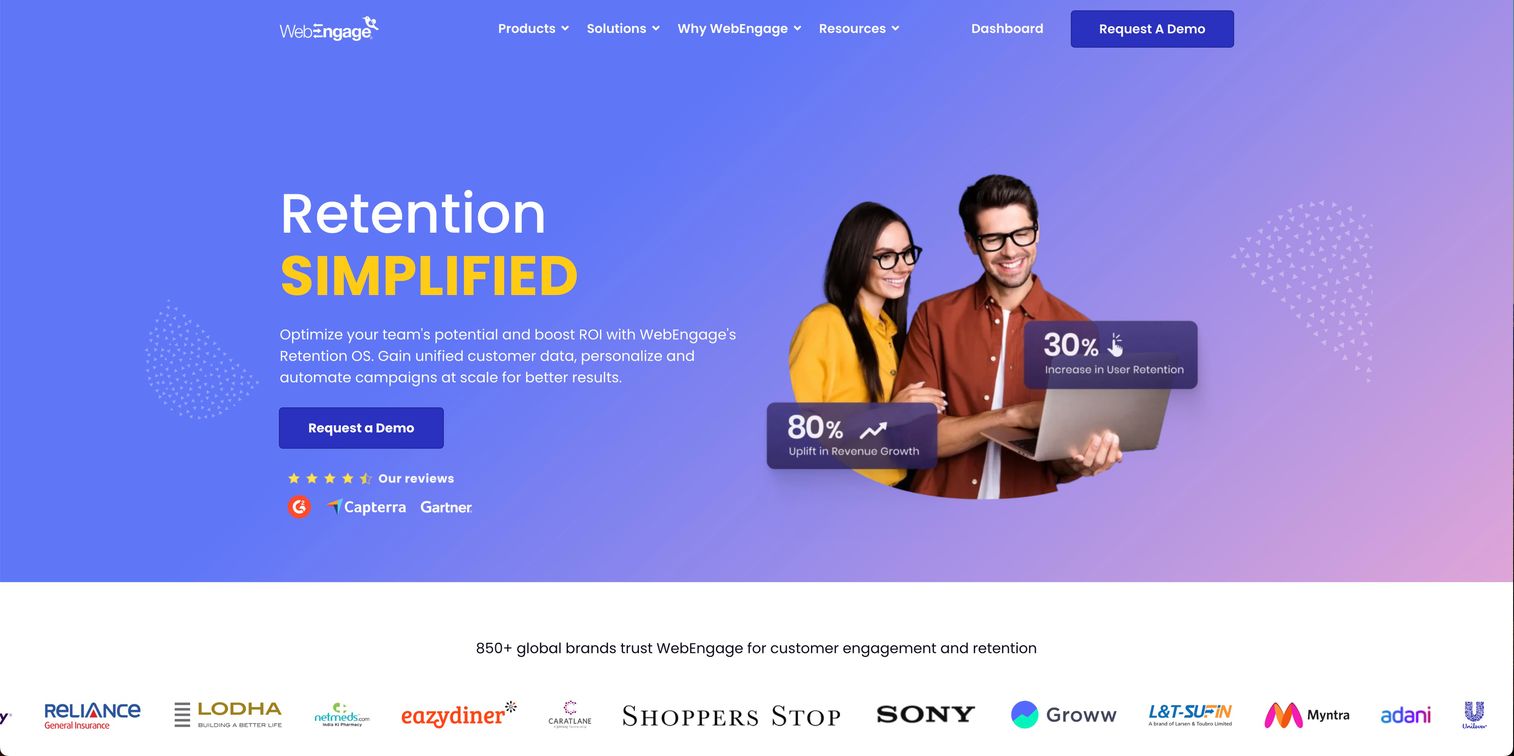
WebEngage is a full-stack retention platform with strong presence in APAC markets.
Best for: Companies with significant user bases in India and Southeast Asia.
Key strengths
- Journey designer: Visual workflow builder for multi-channel campaigns
- Unified customer view: Single profile across web, mobile, and messaging channels
- Regional expertise: Strong support and infrastructure in APAC markets
Pricing: Custom pricing based on monthly active users.
22. Notix
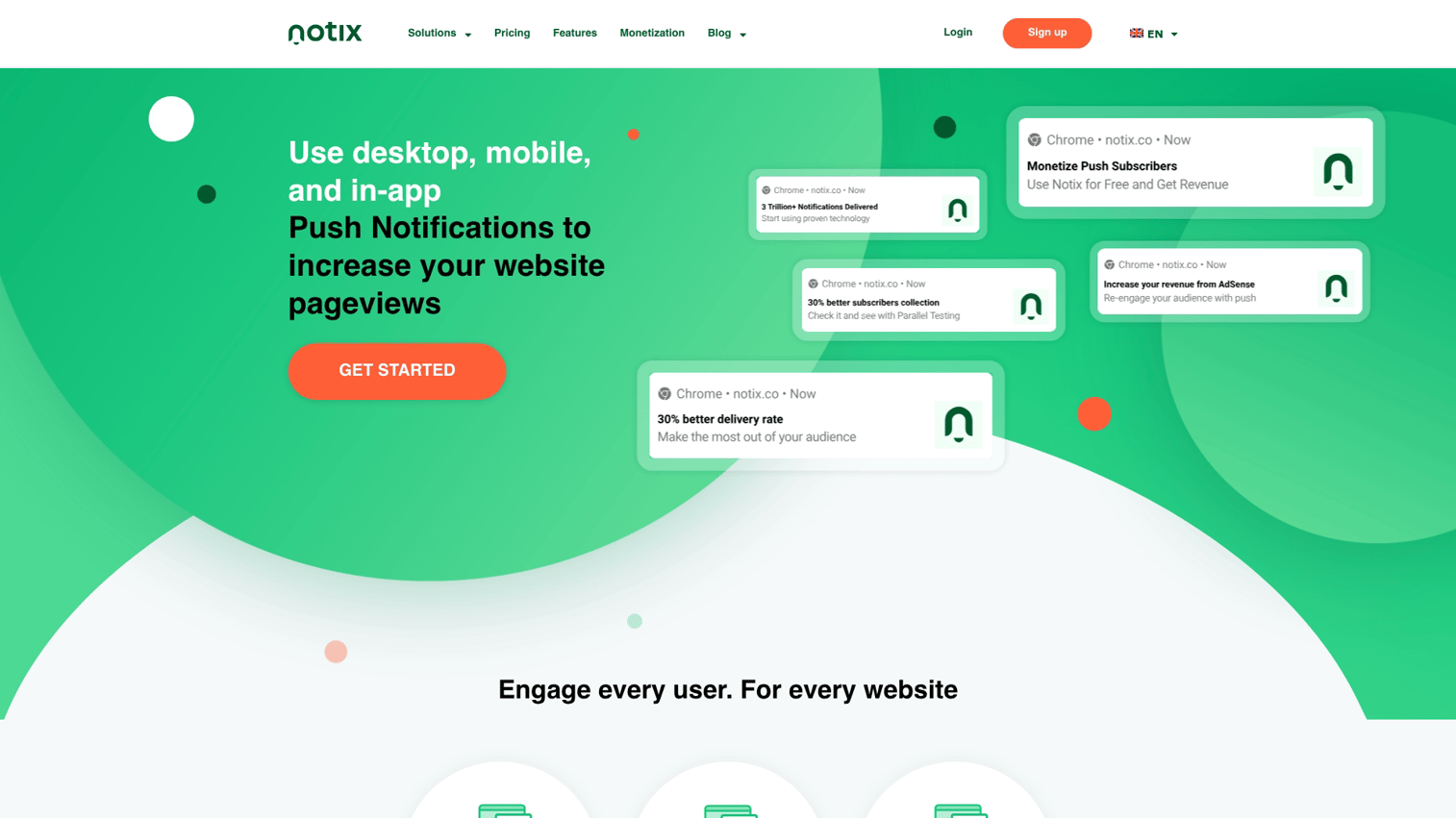
Notix is a web and mobile push notification platform with a generous free tier, popular with publishers.
Best for: Publishers and content sites that want to drive return visits through push notifications.
Key strengths
- Free tier: Generous limits for getting started without cost
- Quick setup: Simple implementation for web and mobile push
- Audience segmentation: Target notifications based on user interests
Pricing: Free plan available. Paid plans start at $5/month.
23. Kumulos
Kumulos is a mobile marketing platform for app developers that includes push notifications, in-app messaging, and app store optimization features.
Best for: App developers and agencies that want mobile marketing tools combined with ASO capabilities.
Key strengths
- Push and in-app messaging: Targeted notifications with deep linking
- App store optimization: Tools to improve app store rankings
- Crash reporting: Identify and fix issues affecting user experience
Pricing: Plans start at $100/month.
24. Localytics
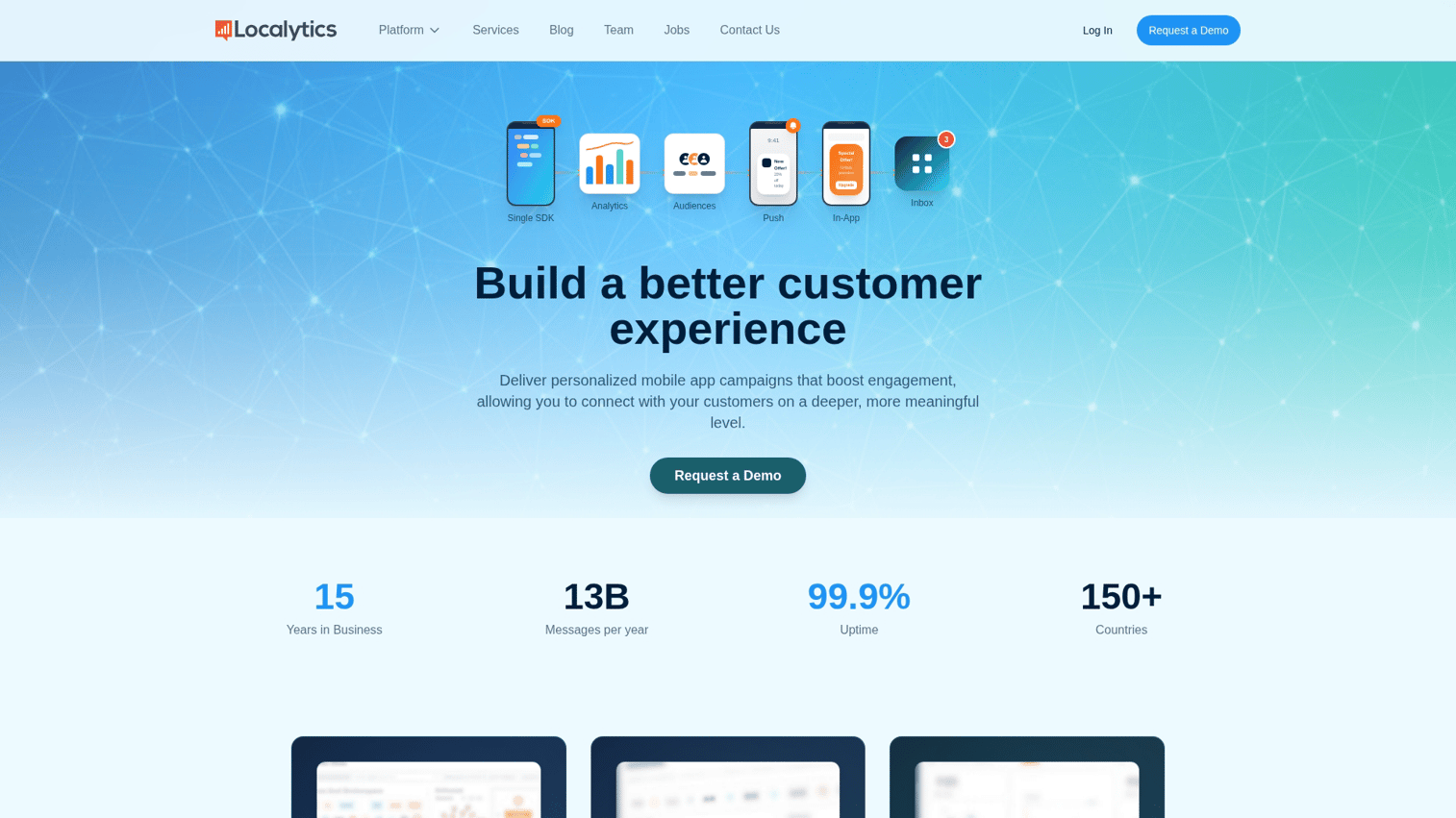
Localytics is a mobile engagement and analytics platform designed for enterprise mobile apps.
Best for: Enterprise companies with large mobile app user bases.
Key strengths
- Behavioral targeting: Segment users based on in-app actions and patterns
- Predictive analytics: Identify users likely to convert or churn
- Enterprise features: Security, compliance, and governance capabilities
Pricing: Custom enterprise pricing.
Key features to look for in mobile marketing platforms
Beyond individual tools, understanding core capabilities helps you evaluate any mobile marketing solution.
SMS and MMS messaging capabilities
Two-way texting enables conversations, not just broadcasts. Look for bulk SMS for promotions, MMS for rich media, and support for both short codes and long codes. TCPA compliance features handle opt-in management, quiet hours, and consent tracking.
Push notification management
Rich push notifications include images, buttons, and interactive elements. Scheduling and frequency capping prevent notification fatigue. Segmentation determines who sees what based on behavior, preferences, and context - Batch's 2025 push benchmark found contextual campaigns achieve a 14.4% open rate versus 4.19% for generic ones.
In-app messaging and engagement
Contextual messages shown inside your app reach users when they're already engaged. Tooltips, banners, modals, and surveys serve different purposes from onboarding guidance to feature announcements.
Mobile marketing automation workflows
Trigger-based messaging responds to user actions automatically. Cart abandonment, inactivity, and milestone events let you reach users at the right moment without manual intervention.
Personalization and audience segmentation
Behavioral segmentation groups users by what they do, not just who they are. Dynamic content adapts messages based on user attributes and context. The depth of personalization often determines engagement rates.
Analytics and campaign attribution
Impression tracking, click-through rates, and conversion tracking show what's working. Multi-touch attribution connects mobile engagement to revenue so you can justify investment and optimize spend.
Integration with CRM and marketing stack
Connections to Salesforce, HubSpot, and data warehouses keep customer profiles synchronized. Evaluate native integrations versus API-only connections, as native integrations typically require less maintenance.
Compliance and message deliverability
Opt-in management, TCPA and GDPR compliance, carrier relationships, and deliverability rates all affect whether your messages actually reach customers.
How to choose the best mobile marketing solution
Selecting the right platform requires a structured evaluation process.
1. Define your mobile marketing objectives
Start with your primary goal: acquisition, engagement, retention, or revenue. Different tools excel at different stages. Match the tool category to your goal before comparing specific vendors.
2. Map your integration requirements
List your existing tools: CRM, CDP, e-commerce platform, analytics. Verify native integrations or API availability for each. Data silos create fragmented customer experiences.
3. Evaluate scalability and pricing tiers
Understand pricing models: per message, per contact, or per monthly active user. Project your growth and ensure the platform scales affordably.
4. Verify security and compliance standards
Check SOC 2 certification, GDPR readiness, and data residency options. For regulated industries, compliance requirements are non-negotiable.
5. Run a pilot before full deployment
Start with a limited campaign or segment. Measure results before expanding. A pilot reveals implementation challenges and performance realities that demos don't show.
Build your mobile marketing stack today
Mobile marketing software spans messaging, engagement, analytics, and demonstration tools. The right choice depends on your specific goals, existing tech stack, and team capabilities.
For teams selling mobile apps to business buyers, removing friction from the evaluation process often matters more than adding another messaging channel. Letting prospects experience your app before they download or schedule a call can improve conversion rates.
Start your journey with Guideflow today!
FAQs about mobile marketing software
Pricing varies from free tiers (OneSignal, Notix) to enterprise contracts exceeding six figures annually. Most platforms price based on message volume, contacts, or monthly active users. SMB tools typically range from $20 to $500 per month.
Basic SMS platforms and push notification tools can launch in days. Enterprise customer engagement platforms may require weeks or months for full integration, data migration, and team training.
Most platforms offer native integrations with major CRMs like Salesforce and HubSpot, plus APIs for custom connections. The depth of integration varies from basic contact sync to real-time behavioral triggers.
SMS marketing sends text messages to phone numbers and works without an app. Push notifications deliver alerts through your mobile app to users who have it installed. SMS has broader reach but higher per-message costs.
Maintain documented opt-in consent before sending messages. Provide clear opt-out mechanisms in every message. Honor quiet hours. Work with platforms that include built-in compliance features.
Focus on delivery rates, open rates, click-through rates, conversion rates, opt-out rates, and revenue attribution.
SMS and push marketing typically deliver strong ROI because of high engagement rates. Many platforms offer free or affordable tiers that scale with your contact list.
Interactive demo platforms let you create browser-based mobile app experiences that prospects can explore without installing anything, reducing friction in the evaluation process.